Showing posts with label Nyonya. Show all posts

Kota

Special thanks to Kota Dine & Coffee for extending this food review invitation.

Fort Cornwallis (Kota Cornwallis) is an imposing fort at the heart of George Town's historic district. The military fortification served as the administrative center of Prince of Wales Island (Penang Island) during the British colonial era. It was named after Charles Cornwallis (1738-1805), the Governor-General of Bengal at the time.
Kota Dine & Coffee is an upscale restaurant inside Fort Cornwallis. The air-conditioned eatery serves local (especially Nyonya) cuisine with a twist of modern influences. A life size statue of Captain Francis Light (1740-1794) greets customers at the restaurant's entrance.
Today's meal begins with Kota's Pie Tee (RM18.00), a popular Peranakan (Nyonya) snack that uses crispy tart shells. The shells are filled with a savory mixture of shredded sole fish, jicama (sengkuang) and carrots. This appetizer comes with scrambled egg, sambal belacan (spicy shrimp paste) and lime.
Next, Otak-Otak Nyonya Fish Custard (RM18.00) is a seafood cake made from fish, squid and scallop. Although seasoned with spices, this delicacy is mildly spicy by Malaysian standards. The word "otak-otak" means "brains" in Malay, which is in reference to its soft texture.
The meal proceeds to Nyonya Lemak Salad (RM18.00), which features a pumpkin bowl with grilled pumpkin and vegetables inside. Thick turmeric dressing serves as dipping sauce. I am also impressed with the unique taste of seaweed tofu. Other salad ingredients are cherry tomatoes, ginger flower, lemongrass and mint leaves.
Kapitan Chicken Burger (RM22.00) integrates the traditional Nyonya-style chicken curry into a modern snack. Besides the chicken patty, burger also contains cheddar cheese, caramelized onion and lettuce. I appreciate the chewy texture of the burger bun. This dish comes with a basket of curly fries.
Moving on, Kota's Chicken Satay (RM22.00) is kept warm over burning charcoal. Sweet-and-spicy peanut sauce is provided. Skewers of pressed rice, cherry tomatoes, shallots and cucumber also take advantage of the dipping sauce. For the satay, I think the taste of turmeric ought to be more prominent.
The next dish is Barramundi Nyonya Sauce (RM28.00). The slice of steamed fish is reasonably firm in texture. It is elegantly flavored with the spicy-sweetness of Nyonya chili sauce. Shimeji mushrooms and okra (lady's fingers) are served on the side. The dish is accompanied by a serving of brown rice that contains black beans, corn kernels, garlic chips and fried leek.
Lamb Shank Curry (RM53.00) is perhaps one of the best dishes at Kota. Cooked in Indian-style curry, the lamb is delightfully tender off the bone. The lamb is rightly paired with a serving of Indian-style basmati rice with ghee, spices and fried leek.
Another recommended dish is Kota Cannonball Chicken Rice (RM25.00). The grilled chicken is beautifully seasoned with honey-sweet sauce, striking a chord with my palate. Between the red chili sauce and green chili sauce, the former seems to work better for me. Meanwhile, the spherical rice balls resemble the ones served at Jonker Walk, Malacca.
To cater to vegetarians, Kota has crafted a handful of meatless dishes. For example, Fried Brown Rice (RM25.00) is served with imitation lamb, scrambled egg, black beans, diced carrot and corn kernels.
The beverage menu includes three iced drinks that are based on calamansi-flavored soda. Firstly, Signature (RM16.00) is concocted from lemongrass, mint leaves and ginger flower. Next, the tangy Sunrise (RM16.00) is prepared from passion fruit, mango, orange and mint leaves, while Sunset (RM16.00) contains a refreshing mixture of watermelon, lychee and mint leaves.
All in all, Kota presents traditional Nyonya dishes in a creative approach. Furthermore, the food presentation here is absolutely commendable; I appreciate the fact that the restaurant uses such refined porcelain tableware!
Admission to Fort Cornwallis is RM10.00 for Malaysian citizens. The ticket price can be deducted from the total bill subjected to minimum spending of RM20.00 per person. It is noteworthy to mention that the restaurant has received halal certification, making it a fine choice of dining to the general public.

Name: Kota Dine & Coffee
Address: Kota Cornwallis, Jalan Tun Syed Sheh Barakbah, 10200 George Town, Pulau Pinang
Contact: 04-371-4929
Business hours: 10:30am-10:30pm
Website: https://www.facebook.com/KotaDineAndCoffee
Coordinates: 5.42068 N, 100.34418 E
Directions: Fort Cornwallis (Kota Cornwallis) is located opposite the Penang State Assembly Building (Bangunan Dewan Undangan Negeri) on Light Street (Lebuh Light). There are two entrances to the fort: at the east and west walls. Street parking is available around the esplanade at Jalan Tun Syed Sheh Barakbah and Jalan Padang Kota Lama. Kota Dine & Coffee is located near the east gate and behind the amphitheater.

Peranakan Passion

Special thanks to Peranakan Passion Nyonya Restaurant for extending this food review invitation.

Update: This business has ceased its operations.

Today's dinner brings me to Peranakan Passion Nyonya Restaurant (娘惹餐厅) at D'Piazza Mall. The Peranakan (Nyonya) community primarily comprises of descendants of Chinese immigrants who settled Southeast Asia between the 15th and 17th centuries. In addition, there are also smaller Peranakan communities of Indian, Arab and Eurasian lineage.
Peranakan Passion is operated by a Peranakan family from Malacca. The family-owned restaurant features the portrait of the matriarch, from whom many of the recipes are derived from. To present a homely Nyonya atmosphere, the dining area is decorated with classic Nyonya ornaments such as traditional attire, porcelain ware and tiffin carriers.
Peranakan Passion specializes in authentic, home-style Peranakan cuisine. Like many traditional Nyonya households, the recipes were inherited from generation to generation. Peranakan Passion's food menu combines signature Nyonya dishes from Malacca, Penang, Singapore and Indonesia.
The restaurant's bestselling dish is Assam Pedas Tau Teh, a renowned delicacy from Malacca. The curry strikes a delicate balance between sour and spicy flavors. The choice of fish is Chinese silver pomfret (斗鲳), a premium choice that is sought-after in seafood restaurants. The dish is also garnished with tomatoes, shallots, mint and bunga kantan (torch ginger).
Fried Rempah Squid is also delectable to the last morsel. In this dish, bite-size squid is stir-fried with a special blend of herbs and spices, giving it a touch of spiciness that tantalizes the palate. The squid is remarkably fresh as evidenced by its delightful springiness.
Another recommended seafood dish is Assam Sauce Prawns. The white shrimps are marinated with savory tamarind sauce for several hours, allowing the sauce to soften the shells and penetrate the crunchy flesh underneath. The prawns may be eaten entirely to savor the true tanginess of tamarind.
Moving on to poultry, Chicken Pongteh (RM20.00) is a popular choice for children and the elderly due to its pleasant taste. Stewed with a rich gravy, the chicken dish contains potatoes, shiitake mushrooms and fermented soybeans. Chicken Pongteh carries a hint of sweet aftertaste due to the presence of gula melaka (palm sugar).
Itik Tim (RM20.00) is a rich soup that contains duck, pickled mustard greens and sour plum. The soup becomes substantially saltier as it cools down, so it should be consumed while it is piping hot.
Despite its simplicity, the appeal of Chincalok Omelette (RM10.00) should not be discounted. Hailing from Malacca, cincalok is made by fermenting a type of shrimp called udang geragau with rice and salt. Pink in its uncooked form, cincalok is extremely pungent and salty. This makes it go particularly well with the eggs.
Meanwhile, Ju Hu Char (RM18.00) is an appetizer of Penang origin. The salad is a combination of shredded jicama (sengkuang), carrots, mushrooms and dried cuttlefish. The cuttlefish is responsible for the dish's characteristic savoriness. Ju Hu Char is usually wrapped in lettuce and eaten by hand. A small amount of chili paste helps to enhance flavor.
Nasi Bakar (RM10.00) is a relatively recent invention from the Indonesian Peranakan community. Although there are over a hundred different variants, Nasi Bakar typically consists of cooked rice that is wrapped in a banana leaf and then grilled over fire. This allows the banana leaf to impart fragrant aroma to the rice.
Peranakan Passion uses premium jasmine rice for Nasi Bakar. The blue coloring is a natural extract of butterfly-pea flowers (bunga telang). Unlike most restaurants, Peranakan Passion uses lots of flowers in order to produce the deep blue color. The flowers are nearly tasteless on their own, so the rice is infused with a variety of herbs to produce the desired aroma and flavor. Also included with Nasi Bakar are omelette and sambal (chili paste).
As for drinks, Peranakan Passion uses honey in lieu of refined sugar. The subtle sweetness of honey delights the taste buds without the surfeiting sensation on the tongue. Shown here are Blue Pea Lemon (RM6.00) and Lemongrass Lime (RM7.00). Both drinks are prepared from genuine ingredients such as butterfly-pea flower, lemongrass, lemon and lime.
Peranakan Passion has extra dining space upstairs for hosting private events. Catering service is also available. To remain faithful to its Nyonya roots, the restaurant does not cut corners when it comes to the authenticity and freshness of ingredients. MSG is notably absent in the food here. It is also important to note that Peranakan Passion is a pork-free restaurant.

Name: Peranakan Passion Nyonya Restaurant (娘惹餐厅)
Address: 70-1-19, D'Piazza Mall, Jalan Mahsuri, 11900 Bayan Lepas, Pulau Pinang
Contact: 018-462-5608
Business hours: 11:30am-3:00pm, 6:00pm-9:30pm (Tuesday-Friday), 5:00pm-10:00pm (Saturday-Sunday), closed on Mondays
Website: https://www.facebook.com/peranakanpassion
Coordinates: 5.32661 N, 100.28311 E
Directions: Peranakan Passion is located at D'Piazza in Bayan Baru. The restaurant is several shops after Sweet-i. Outdoor parking and basement parking are available at D'Piazza.

Lobby Lounge

Special thanks to Shangri-La Hotel Singapore for extending this food review invitation.

There are plenty of dining options at Shangri-La Hotel Singapore. The Lobby Lounge is one of the many restaurants in this 5-star hotel. Located at the Tower Wing's lobby, the eatery is separated from the hotel's reception by an infinity pool with "floating candles". Behind the bar is an imposing basalt wall that rises to the ceiling. Crevices on the rock's surface are covered with ferns and mosses, presenting the appearance of a warm tropical oasis.
The Lobby Lounge provides a comfortable setting for casual family dining. Although there are proper dining tables, most guests prefer low coffee tables with comfortable café chairs. In addition, there are also cozy couches next to the glass walls. A small library at the back is stocked with reading materials for guests to pass the time.
The food menu here leans towards local Singaporean heritage fare. There are 6 signature dishes to choose from, each of which is inspired by a popular stall in Singapore's hawker scene. The Local Semi-Buffet Lunch is highly recommended. This offer allows the guest to pick a signature dish and drink, plus unlimited access to the buffet.
For the signature dish, we were eyeing for the Chilli Crab & Mantou (辣椒螃蟹和馒头) but this delicacy is unfortunately not available today. Therefore, our first choice is Bak Chor Mee (肉脞面), a noodle dish of Teochew (潮州) origin. This dish is inspired by the recipe at Seng Kee Mushroom Minced Meat Noodle (胜记香菇肉脞面) at Serangoon Garden Market.
Bak Chor Mee is tossed in a dark sauce that is prepared from soy sauce, vinegar and pork lard. Minced pork, mushrooms and chopped scallion are added on top. However, it is the dried sole (鳎目鱼干) that does the heavy lifting to the overall taste.
Served with Bak Chor Mee is a bowl of fish maw soup (鱼肚汤). Stewed from pork bones, the soup is loaded with threadfin (马鲛鱼) fish maw, pork slices and eggs. The soup's taste is absolutely satisfying.

Another popular dish from the menu is Fish Bee Hoon (鲜鱼米粉汤). This crowd favorite is based on the original recipe at Ka-Soh Restaurant (家嫂). Boiling hamachi (鰤鱼) bones for several hours culminated in a rich soup of creamy consistency. However unlike most recipes in Malaysia, no evaporated milk is used to prepare this soup.
Thick rice noodle called "lai fun" (濑粉) is used here. We also enjoy the delectable slices of giant snakehead (巨型鳢鱼). The fish is tender and succulent, making every bite gratifying indeed. Just before serving, a dash of XO brandy is added to suppress the strong fishy smell.
Meanwhile, the buffet counters present a variety of Peranakan dishes. Also known as Nyonya, the Peranakan culture is the legacy of early Chinese migrants who settled down in Penang, Malacca and Singapore several centuries ago. Back then, these territories were under direct British control and were collectively known as the Straits Settlements.
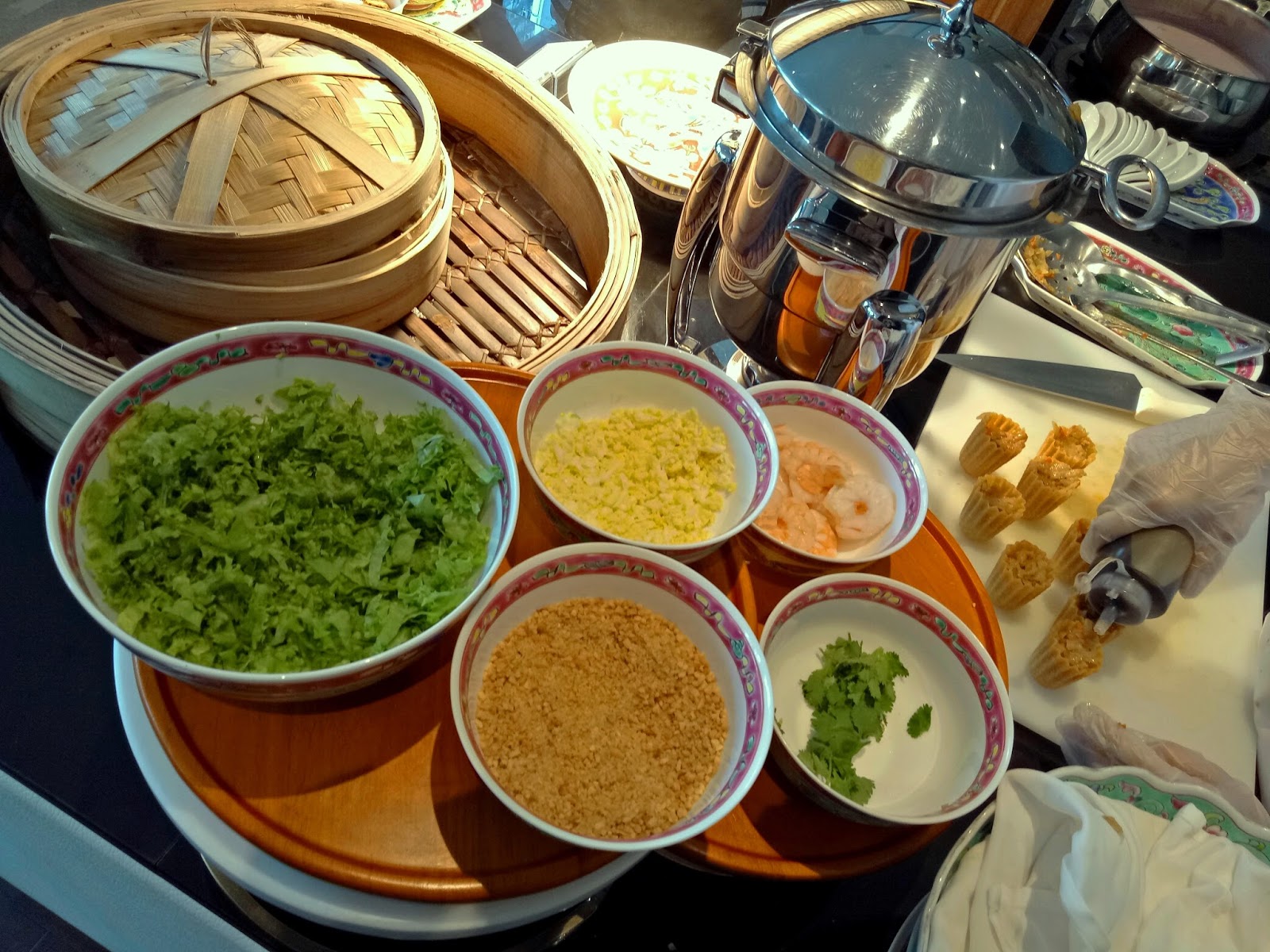
Starting with appetizers, Pie Tee consists of crispy tart shells filled with shredded carrots and jicama (凉薯). Cooked shrimps, omelette, dark sauce, chili sauce and coriander are also added to enhance its flavor.
Popiah (薄饼) is a snack from Fujian (福建), a province in China from which the majority of ethnic Chinese in Singapore descended from. Wrapped in soft skin made from wheat flour, Popiah is typically filled with carrots, jicama, omelette, crushed peanuts, lettuce and fried shallots. Unlike Spring Roll, Popiah is never deep-fried.
Achar is a pickled vegetable dish that consists of julienned cucumbers and carrots in sweet-sour-spicy dressing. Crushed peanuts and sesame seeds are sprinkled on top to improve the salad's mouthfeel. Like other Nyonya dishes, Achar is served using porcelain tableware reminiscent of the pre-modern days of China.
Beef Rendang is a traditional Minangkabau delicacy that is usually reserved for festive occasions and wedding ceremonies. The spicy dish contains bite-size chunks of beef seasoned with galangal, turmeric, lemongrass and other spices. Beef is slow-braised for hours until most liquid has boiled away, resulting in a savory dish saturated with essences of coconut milk and spices.
Ayam Ponteh is a popular Nyonya dish which contains chunks of chicken and potato. The thick gravy is made from fermented soybean paste (豆酱) and gula melaka (palm sugar). Another poultry dish which deserves special mention is Duck With Salted Vegetable Soup.
Jellyfish With Sesame has similar taste and texture to its Japanese counterpart, chuka kurage (中華クラゲ). Meanwhile for Tofu Skin, yuba sheets are cut into long, thin strips that resemble noodles.
Next, Nyonya Assam Pedas Fish is cooked in spicy gravy. The gravy's fiery aroma comes from red chili peppers, while tamarind pulp is responsible for providing sourness. Cooked with battered fish fillets are assorted vegetables such as okra (lady's fingers), eggplant (brinjal), yardlong beans, shallots and tomato. Sambal Vegetables is the vegetarian equivalent of this dish.
The desserts section presents a number of traditional Nyonya kuih. These traditional snacks are supplied by HarriAnns, a local family business which specializes in Peranakan recipes. Kueh Sago Melaka is made from sago pearls and gula melaka, while Kueh Lavender is infused with genuine lavender extract. Other delectable choices are Ondeh Ondeh, Peanut Ang Ku Kueh, Kueh Salat, Kueh Lapis and Kueh Rainbow Lapis.
Cheng Teng (清汤) is a sweet syrup with scrumptious ingredients like white fungus (银耳) and longan (龙眼). The dessert is usually served warm. Meanwhile, Bubur Cha-Cha derives its creaminess from coconut milk. The warm, starchy soup also contains sweet potatoes, taro, black-eyed peas and sago pearls.
As for drinks, guests may opt for endless flow of Teh Tarik and Kopi C. Each drink is prepared by repeatedly "pulling" it between two cups. This process allows the drink to cool down and gives it a frothy top. Other drinks of the menu are Barley, Bandung, Chin Chow, Milo Dinosaur and Milo Over-The-Top.
The Local Semi-Buffet Lunch is available from 11:30am to 2:30pm on weekdays (SGD42.00), and from 11:30am to 4:00pm on weekends and public holidays (SGD48.00). As for entertainment, live music is performed here every evening except on Sundays. The current star is the lovely Tria Bascon, who will be delighting the audience with classic jazz songs until 12 May 2018.

Name: The Lobby Lounge
Address: 22 Orange Grove Road, Singapore 258350
Contact: +65-6213-4288
Business hours: 7:30am-1:00am
Website: http://www.shangri-la.com/singapore/shangrila/dining/bars-lounges/lobby-lounge
Coordinates: 1.31141 N, 103.82639 E
Directions: Shangri-La Hotel Singapore is located along Orange Grove Road. The Lobby Lounge is located at the lobby of the Tower Wing. Shangri-La Hotel provides complimentary parking for its guests.

Kota

Special thanks to Kota Dine & Coffee for extending this food review invitation.

Fort Cornwallis (Kota Cornwallis) is among the oldest remnants of British presence in Malaysia. As the first British outpost in modern-day Malaysia, Prince of Wales Island (the colonial name for Penang Island) was an important entrepôt of the lucrative spice trade. Fort Cornwallis was constructed in 1786 to defend this British settlement against other colonial powers.
Near the east gate and behind the amphitheater is Kota Dine & Coffee. This air-conditioned restaurant specializes in modernist Nyonya (Peranakan) cuisine. The food menu modifies traditional Nyonya recipes to be presented in truly unconventional forms. As Kota has recently obtained halal certification, its doors are open to a wider range of customers.
Customers are greeted with a statue of Captain Francis Light (1740-1794) at the entrance of the restaurant. A historical flashback: Francis Light founded Penang in 1786 after being granted permission by the Kedah Sultanate, in exchange for British military protection against the Kingdom of Siam - a promise which he later renegaded when the Siamese army did invade Kedah in 1821.
For appetizer, the Jumbo Platter (RM38.00) is the best choice as it is a combination of other appetizer dishes. Pie tee (小金杯) consists of crispy edible cups that are filled with julienned jicama (sengkuang) and carrots. In an interesting twist, Japanese-style shrimp roe (えびこ) is also used.
Meanwhile, the crispy yam puff (芋角) contains stewed chicken fillings. Other delicacies include turmeric chicken, tandoori chicken, kerabu, Chinese bun (馒头) and sambal belacan (spicy shrimp paste).

Kota Asam Pedas (RM32.00) features a bowl of seafood curry with fried rice on the side. Apart from saltiness of dried shrimps, the rice has milder flavor in order not to steal the limelight from the bowl of curry.
The curry is rather milky in consistency due to a copious amount of coconut milk. Besides being spicy, the curry also carries appetizing sourness thanks to the presence of tamarind (asam) juice. Also included in the curry are salmon, shrimps and pineapples.
My favorite dish today is the Satay (RM25.00), which is inspired by the titular street food but is presented in a peculiar manner. Like its traditional counterpart, chicken is sweetened and marinated in a turmeric-centric spice mix, and then grilled over flame.
But instead of being served on skewers, the grilled chicken is rolled with nasi impit (pressed rice). The roulade is then covered with signature peanut sauce. Cucumber, onion and coriander are used as garnish. Overall, I feel that all ingredients assimilate well with one another.

The next dish, Nyonya (RM25.00), is inspired by Peranakan-style nasi lemak. Otak-otak serves as the base. The next layer is steamed rice that is infused with coconut milk and is colored by butterfly-pea flower. Rendang chicken and acar serve as primary components of this dish, while fried leek is just icing on the cake.
At Kota, Nyonya nasi lemak is also the source of inspiration of an unorthodox dessert. Instead of being a breakfast dish, Nasi Lemak Cake (RM19.00) uses the nasi lemak's typical ingredients to create a sweet-savory treat. The cake is very soft when cut, yet it is firm enough to retain its form without crumbling.
At the base of the cake is a layer of biscuit that is flavored with sambal (spicy chili paste). This is followed by cooked rice dyed with butterfly-pea flower essence. Moving upwards, the next layers are sponge cake, coconut milk cream and cucumber-flavored jelly. At the side are caramelized anchovies and peanuts.

The Cream Brulee (RM19.00) assimilates the French custard dessert with ingredients from the East. The top surface of this rich custard is flambéed to produce a layer of caramel. There are 3 types of crème brûlée here - each is flavored with pandan, black glutinous rice or gula melaka (palm sugar). I feel that the gula melaka variant is particularly enjoyable due to its distinctive sugary aroma.
As for drinks, Kota Flavor is a new series of carbonated drinks. For example, the refreshing glass of Signature (RM16.00) is made from sweetened soda water with lemongrass juice, lime wedges, mint leaves and ginger flower. Interestingly, red chili pepper is added to impart some fiery sensation.
Sunrise (RM16.00) is another fizzy drink which uses orange juice as the base. Lime and mango provide a secondary line of tanginess, while mint leaves produce cooling sensation as the drink trickles down the throat.
Finally, the pink-colored Sunset (RM16.00) contains actual watermelon pieces, lending a rejuvenating sense of freshness. Also included in this fruity drink are lime and mint leaves.
Overall, Kota's menu presents an interesting array of Nyonya delicacies with creative twists of modernity. Similar to traditional Nyonya cuisine, the food here takes a liberal approach in using local spices for seasoning. Kota also places strong emphasis on food presentation. Indeed, most dishes are elegantly plated on decorative porcelain plates.
Next to the common dining section is a private room which accommodates up to 20 people. Usage of this room is subjected to minimum spending of RM1,500.00. Although customers are charged an admission fee at the entrance of Fort Cornwallis, RM10.00 (per person) is deducted from the restaurant's bill as long as there is minimum spending of RM20.00 per person.

Name: Kota Dine & Coffee
Address: Kota Cornwallis, Jalan Tun Syed Sheh Barakbah, 10200 George Town, Pulau Pinang
Contact: 04-371-4929
Business hours: 10:30am-10:30pm
Website: https://www.facebook.com/KotaDineAndCoffee
Coordinates: 5.42068 N, 100.34418 E
Directions: Fort Cornwallis (Kota Cornwallis) is located opposite the Penang State Assembly Building (Bangunan Dewan Undangan Negeri) on Light Street (Lebuh Light). There are two entrances to the fort: at the east and west walls. Street parking is available around the esplanade at Jalan Tun Syed Sheh Barakbah and Jalan Padang Kota Lama. Kota Dine & Coffee is located near the east gate and behind the amphitheater.